
When parents disagree about where a child should attend school, the dispute can become one of the most contested issues in a Miami divorce. School placement affects academics, friendships, transportation, and daily quality of life, and the stakes are high. Segarra & Associates, P.A. represents parents in school-placement disputes and helps families navigate education-related decisions in parenting plans and divorce agreements. Early legal strategy can help you meet critical deadlines, avoid costly mistakes, and build a case focused on your child's best interests."
Book a Confidential Consultation with Segarra & Associates, P.A. Call (305) 742-5042.
School Placement Disputes in Florida: Strategy, Evidence & Preparing to Win
Few parenting disputes become contentious faster than the question: Where is our child going to school?
Public or private? The neighborhood school or a magnet program? Mom's school zone or Dad's? Stay where the child has always attended or move to a school that one parent believes offers better opportunities?
On paper, these may sound like educational decisions. In a courtroom, they can become some of the most complicated and heavily contested parenting disputes we handle.
At Segarra & Associates, P.A., school placement disputes are an important part of our family law practice. Our attorneys have extensive experience litigating parenting and time-sharing cases, and we approach school placement disputes the same way we approach other significant trial issues: develop the strategy early, identify the evidence that matters, prepare the witnesses, and build the case around the child's best interests.
Because when parents cannot agree, telling a judge that one school is "better" usually isn't enough. You have to prove your case.
School Placement Is About Much More Than Which School Has Better Ratings
Parents understandably focus on the schools themselves.
Which school has better academics?
Which has the stronger gifted program?
What are the class sizes?
Which has better extracurricular activities?
Those things can certainly matter.
But a school-placement dispute rarely turns on a Great Schools rating or which campus looks better during a tour.
The court must consider the child's best interests, and school placement often intersects with a much broader set of issues:
-
the child's educational history and needs
-
continuity and stability
-
the existing parenting plan
-
each parent's involvement in the child's education
-
transportation and commute times
-
the parents' work schedules
-
the time-sharing arrangement
-
before- and after-school care
-
the child's friendships and community ties
-
extracurricular activities
-
special educational needs
-
the practical ability of each parent to make the proposed school arrangement actually work
The best school on paper is not necessarily the best school for this particular child. That distinction can decide the case.
The First Question: Who Actually Has Authority to Make the Decision?
Before arguing about which school the child should attend, we first look at something much more basic: Who has the legal authority to make the educational decision?
Florida parenting plans address parental responsibility and may specify how major educational decisions are made. Some parents share educational decision-making. In other cases, a court order may give one parent ultimate decision-making authority over education or otherwise address school placement.
The exact language matters a lot.
One of the first things we do in a school-placement dispute is carefully review the Final Judgment, parenting plan, and subsequent orders to determine what authority already exists and what relief may actually need to be requested from the court.
A parent should not assume that because a child lives primarily with that parent, or because a particular school is located within that parent's residential zone, that the parent automatically has unilateral authority to change schools.
Making the move first and asking questions later can be an expensive mistake.
Timing Can Win or Lose a School Placement Case
This is one of the most important lessons we can give parents: Do not wait until the week before school starts to address a school-placement dispute.
These cases have a clock. Applications have deadlines. Magnet and charter programs have lotteries. Private schools have enrollment deadlines and deposits. Teachers and school administrators become harder to reach during summer, and judges have crowded calendars.
If you know in February that you and the other parent disagree about where your child should attend school in August, February is the time to start addressing it, not July 25th.
Waiting can severely limit your options.
Early preparation gives your lawyer time to evaluate the parenting plan, communicate with the other parent, attempt resolution, conduct discovery when necessary, obtain school records, identify witnesses, issue subpoenas, schedule depositions where appropriate, mediate the dispute, and, if necessary, obtain sufficient hearing time before the school year begins.
A strong school-placement case begins with a calendar.
How Do You Win a School Placement Dispute?
There is no magic document and no single factor that guarantees victory.
But after years of litigating parenting disputes, we have learned something important:
The strongest school-placement cases are built around the child, not around which parent wants to win.
A parent walking into court saying, "This is a much better school," is making an argument.
A parent who can demonstrate why that school better serves this particular child's academic, developmental, emotional, logistical, and educational needs is presenting a case.
There is a major difference.
Our job is to help build that case.
Evidence Wins Cases, Opinions Usually Don't
Parents know their children better than almost anyone. But there is an inherent problem in contested litigation: Both parents have an opinion.
And usually those opinions are opposite.
That is why independent evidence can become so powerful.
Depending upon the case, relevant evidence may include school records, report cards, standardized testing, attendance records, disciplinary history, IEPs and 504 plans, evaluations, communications with teachers, information regarding specialized programs, transportation evidence, extracurricular schedules, and evidence concerning each parent's historical involvement with the child's education.
But gathering documents is only the beginning.
The real question is: How are we going to get the evidence in front of the judge?
That is where trial experience matters.
The Right Witness Can Change the Case

One of the most overlooked aspects of school-placement litigation is witness selection. Parents sometimes arrive at a consultation with a list of relatives and friends prepared to testify that they are wonderful parents. That may not answer the school-placement question.
We want to identify witnesses who have actual knowledge relevant to the child and the educational dispute.
Depending upon the case, that may include:
Teachers
A teacher may have firsthand knowledge of the child's academic performance, classroom behavior, learning style, social adjustment, strengths, weaknesses, or response to the existing school environment.
Guidance Counselors
Counselors may have valuable information regarding academic planning, social issues, specialized programs, or the child's educational needs.
School Administrators
Principals, assistant principals, registrars, or program administrators may be necessary to establish enrollment requirements, available programs, school policies, or other facts relevant to a proposed placement.
Therapists or Other Professionals
When appropriate and legally permissible, professionals working with the child may possess information relevant to how a proposed change could affect the child's particular needs.
Educational or Special-Needs Professionals
Cases involving an IEP, Section 504 plan, gifted placement, learning disability, or specialized educational program may require evidence that goes well beyond comparing two schools.
The goal isn't to bring the most witnesses.
It's to bring the right witnesses.
And Then There Is Hearsay...
This is where otherwise good cases sometimes get into trouble.
A parent may come to court prepared to testify:
"His teacher told me..."
"The principal said..."
"The counselor thinks..."
And opposing counsel stands up: Objection. Hearsay.
Suddenly, information the parent believed was central to the case may never reach the judge in the manner the parent expected.
That is why trial preparation begins well before the hearing. If a teacher has important information, we evaluate whether that teacher needs to testify. If school records are important, we determine how they will be obtained and admitted. If an administrator possesses necessary information, we consider whether a subpoena is appropriate. If testimony needs to be preserved through deposition or another permissible procedure, that decision should be made early.
Knowing something happened is not the same as being able to prove it in court. That distinction is one of the most important parts of preparing any contested family law case.
Public School vs. Private School
These disputes are common, and they are rarely as simple as one parent believing private school is "better."
The analysis may involve the child's educational history, whether the child is already thriving, the particular programs offered, class size, special needs, transportation, tuition and the parties' ability or obligation to pay it, the child's extracurricular activities, and the practical effect on the parenting plan.
A $30,000-a-year private school is not automatically better for a child because it costs $30,000. Likewise, the fact that a public school costs nothing does not automatically make it the appropriate choice. The focus should remain on this child, this family, and the evidence.
Magnet, Charter and Specialized Programs
Magnet, charter, gifted, and specialized programs present their own challenges because decisions frequently must be made long before the first day of school.
Application deadlines and lotteries do not wait for family court. If one parent wants a child to apply to a competitive program and the other objects, waiting until an acceptance letter arrives may create unnecessary complications. These cases are another example of why early legal strategy matters.
Sometimes the first battle isn't whether the child will attend the school. It's whether the child should even be permitted to apply.
IEPs, 504 Plans and Children With Special Educational Needs
When a child has special educational needs, school placement requires even greater care.
A proposed move may affect services, accommodations, therapies, classroom settings, transportation, continuity with existing educators, and the child's overall educational progress.
These cases can involve extensive educational records and testimony from people who actually understand the child's needs.
The court does not need two parents simply arguing about which school they prefer. The court needs reliable evidence showing what this particular child needs and which proposed placement is best positioned to provide it.
Transportation Matters More Than Parents Think
We have seen parents spend enormous amounts of time arguing about academics while overlooking a question the judge is almost certainly going to ask:
How is this actually going to work every day?
If the proposed school requires a child to spend an additional hour in the car each morning and afternoon, that matters.
If one parent's work schedule makes pickup impossible, that matters.
If attending a particular school makes the existing time-sharing schedule impractical, that matters.
If transportation interferes with tutoring, therapy, sports, homework, or sleep, that may matter too.
Judges are not simply choosing schools. They are evaluating real lives and real children.
Your proposed solution needs to work on Monday morning, not just look good in a courtroom exhibit.
School Placement and Relocation
School disputes also frequently intersect with relocation. A parent's move can affect school zoning, transportation, time-sharing, extracurricular activities, and the child's connection to an existing community.
Florida relocation cases are governed by their own statutory requirements and should not be treated as ordinary school-choice disputes.
A parent considering a move that may constitute relocation under Florida law should obtain legal advice before moving with the child, not afterward.
School placement may be an important part of the relocation analysis, but it is only one part of a much larger legal issue.
Sometimes the Best Strategy Is Not Trial
We are trial lawyers. But that does not mean every school dispute should end with a judge choosing between School A and School B. In fact, a good litigation strategy sometimes creates the leverage necessary to avoid trial altogether.
If the other parent and opposing counsel see that the case has been properly developed—that the records have been obtained, witnesses identified, subpoenas issued when appropriate, and the evidence organized around the child's best interests—mediation and settlement discussions can become much more productive.
Preparation gives you options. If the case settles, excellent. If it doesn't, you're ready.
Common Mistakes We See in School Placement Disputes
Some mistakes occur over and over again.
-
Waiting until summer to address a dispute that has existed for months.
-
Unilaterally enrolling the child without first understanding the parenting plan.
-
Assuming the school with the higher online rating automatically wins.
-
Building the case around what is more convenient for the parent rather than what is best for the child.
-
Relying entirely on what teachers or counselors allegedly said without determining how that information will be admitted into evidence.
-
Failing to subpoena a necessary witness until it is too late.
-
Ignoring transportation and the practical effect of the proposed school on time-sharing.
And perhaps the biggest mistake: Treating school placement like an afterthought. It isn't.
Where a child spends six or seven hours every weekday can affect academics, friendships, activities, transportation, parental involvement, and the child's daily quality of life. These cases deserve serious preparation.
Why Choose Segarra & Associates for a School Placement Dispute?
School-placement cases sit at the intersection of two things we know extremely well: children and the courtroom.
Segarra & Associates, P.A. represents parents in contested Florida family law cases involving school placement, parental responsibility, time-sharing, relocation, and other significant issues affecting children.
Our approach to school-placement disputes is shaped by trial experience and a focus on building evidence-based cases around the child's best interests.
Our school-placement dispute strategy begins with evidence, not emotion. We ask why a proposed school benefits this child, what the existing court order permits, which witnesses have firsthand knowledge, what records are needed, and how to present the strongest child-centered case to the judge.
Because when parents cannot agree about something as important as their child's education, preparation matters.
Strategy matters. Evidence matters. And timing matters.
If you are facing a school-placement dispute or believe one may be developing for the upcoming school year, call Segarra & Associates, P.A. early. Early legal strategy can help you meet application deadlines, avoid costly mistakes, and build a stronger case around your child's needs.
Frequently Asked Questions
Can one parent simply change the child's school?
It depends upon the existing parenting plan, Final Judgment, and allocation of parental responsibility and educational decision-making authority.
A parent should carefully review the existing court orders before making a unilateral school change. When parents share responsibility for educational decisions, unilateral action may create significant legal problems.
What happens if we cannot agree before school starts?
Do not wait. If negotiations and mediation cannot resolve the issue, court intervention may become necessary. Because hearing availability and school deadlines can create significant timing problems, parents should seek legal advice as early as possible.
Does the parent with more overnights automatically get to choose the school?
Not necessarily. The parenting plan and court orders governing educational decision-making are critical. The child's best interests also remain central to any disputed issue presented to the court.
Will the judge simply choose whichever school has the better rating?
No single school ranking decides the case. The court may consider evidence regarding the child's individual needs, academic history, stability, transportation, programs, parental involvement, time-sharing logistics, and other circumstances relevant to the child's best interests.
Can my child's teacher testify?
Potentially, yes. Teachers can sometimes provide valuable firsthand evidence regarding a child's academic performance, educational needs, behavior, adjustment, and existing school experience.
Whether a particular teacher should testify is a strategic decision that should be evaluated based upon the facts of the case.
Can I tell the judge what my child's teacher told me?
Maybe, but don't assume you can. Statements made outside the courtroom can raise hearsay and other evidentiary issues. If information from a teacher, counselor, administrator, or other professional is important to your case, your attorney should evaluate in advance how that evidence can properly be presented.
Can the judge consider what my child wants?
Florida law permits courts, under appropriate circumstances, to consider the reasonable preference of a child whom the court determines has sufficient intelligence, understanding, and experience to express a preference. There is no magic age at which a child simply gets to choose a school. And involving children directly in parental litigation should be approached very carefully.
What if my child has an IEP or 504 plan?
That can be extremely important. The analysis may include the child's existing services and accommodations, available programs at the proposed schools, continuity, evaluations, and testimony or records from relevant educational professionals.
Can school placement affect time-sharing?
Absolutely. School location can affect transportation, exchanges, before- and after-school care, extracurricular activities, and whether an existing time-sharing schedule remains practical. Sometimes what begins as a school-placement dispute becomes part of a broader parenting-plan modification case.
When should I contact an attorney about a school dispute for next year?
As early as you reasonably know there is a genuine disagreement. Waiting until shortly before school begins can severely limit the time available for negotiation, mediation, discovery, witness preparation, and obtaining a court hearing if necessary.
Discussing School Placement With Segarra & Associates
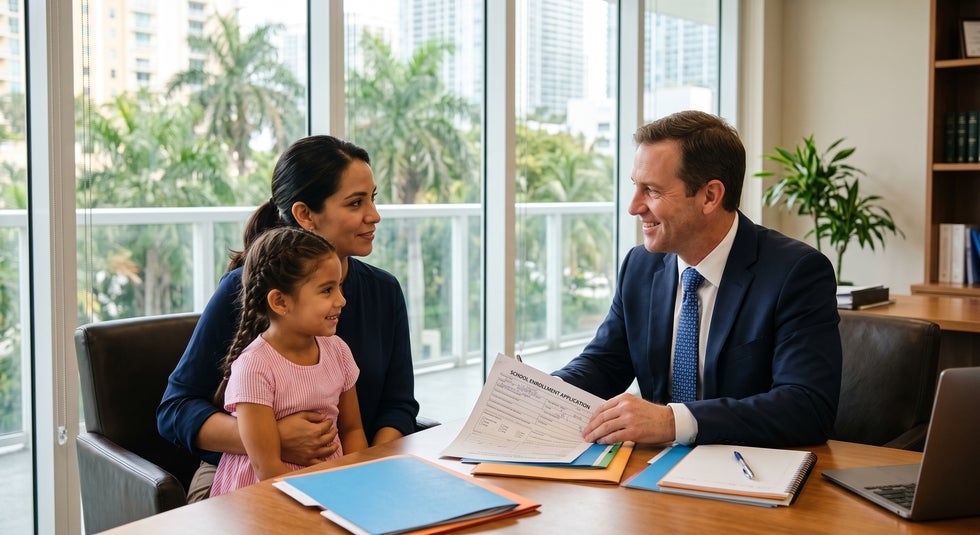
Education-related issues can be part of the broader parenting-plan and settlement process in a Miami divorce. Segarra & Associates represents clients in Miami family-law matters, including parenting-plan and education-related disputes where applicable.
Schedule a consultation with Segarra & Associates to discuss your school-placement concerns and available legal options.
Call Segarra & Associates, P.A. at (305) 742-5042
Disclaimer: This article provides general information and does not serve as legal advice. For legal concerns, consult a licensed attorney. Viewing or interacting with this content does not create an attorney-client relationship. This includes submitting a form, leaving a comment, sending a message, making a call, or leaving a voicemail. Laws may vary by jurisdiction. Laws are subject to change; always verify current legal requirements with a qualified professional. Remember that each case is different, the results of each case will vary, and that all videos posted on this website are not legal advice.
© All Rights Reserved.
Engagement Notice:
An attorney–client relationship with Segarra & Associates, P.A. begins only upon a written agreement and retainer payment, confirmed in a signed engagement letter. Do not send confidential information until such an agreement is executed.
Jurisdictional Statement:
Segarra & Associates, P.A. practices law exclusively within the State of Florida. Representation in other jurisdictions may involve association with local counsel.