
Equitable distribution is the part of a Florida divorce that divides marital property and debts fairly, and fair doesn't always mean a perfect 50/50 split. First, build a clear inventory of what you own and owe—homes, retirement accounts, credit cards, and business interests. Because one decision affects many others, Segarra & Associates, P.A. helps you stay organized, separate marital from nonmarital items, and move toward a workable plan.

Dividing Property in Divorce? Get Legal Guidance First.
Call Segarra & Associates, P.A. at (305) 742-5042
Identification of Marital vs. Non‑Marital Assets
Before dividing property or debts, the court must clearly identify what is marital and what is non‑marital. This classification step comes first because the court can only equitably distribute marital assets and liabilities; non‑marital property generally remains with the spouse who owns it.
In practice, the judge will determine, asset by asset and debt by debt, whether each item was acquired during the marriage with marital funds or efforts (typically marital), or whether it falls into a non‑marital category, such as property owned by a spouse before the marriage, gifts or inheritances to one spouse alone, or items excluded by a valid agreement. The court then lists or otherwise sets out which assets and liabilities are marital and which are non‑marital so that the distribution analysis applies only to the marital category.
Presumption of Florida Equal Distribution
Florida courts begin equitable distribution with the presumption that marital assets and liabilities should be divided equally between the spouses. This means a 50/50 split is the starting point, not the guaranteed outcome. The court then considers the statutory equitable-distribution factors—such as each spouse's contributions to the marriage, their economic circumstances, and any dissipation of assets—to decide whether an unequal division is justified. Florida Statutes § 61.075(1) sets this presumption of equal distribution.
If the evidence does not support deviating from equality, the court will typically adhere to an equal allocation of the net marital estate. If you want the court to treat something as nonmarital, you usually need proof that supports that classification.
Factors Courts Use to Classify Marital Assets and Liabilities

Equitable distribution refers to the way a couple's assets and debts are divided between the parties during a divorce and is governed by Florida Statutes Section 61.075. Pursuant to s. 61.075, in a proceeding for dissolution of marriage, in addition to all other remedies available to a court to do equity between the parties, the court shall set apart to each spouse that spouse's non-marital assets and liabilities, and in distributing the marital assets and liabilities between the parties, the court must begin with the premise that the distribution should be equal, unless there is a justification for an unequal distribution based on all relevant factors, including:
-
The contribution to the marriage by each spouse, including contributions to the care and education of the children and services as homemaker.
-
The economic circumstances of the parties.
-
The duration of the marriage.
-
Any interruption of personal careers or educational opportunities of either party.
-
The contribution of one spouse to the personal career or educational opportunity of the other spouse.
-
The desirability of retaining any asset, including an interest in a business, corporation, or professional practice, intact and free from any claim or interference by the other party.
-
The contribution of each spouse to the acquisition, enhancement, and production of income or the improvement of, or the incurring of liabilities to, both the marital assets and the nonmarital assets of the parties.
-
The desirability of retaining the marital home as a residence for any dependent child of the marriage, or any other party, when it would be equitable to do so, it is in the best interest of the child or that party, and it is financially feasible for the parties to maintain the residence until the child is emancipated or until exclusive possession is otherwise terminated by a court of competent jurisdiction. In making this determination, the court shall first determine if it would be in the best interest of the dependent child to remain in the marital home; and, if not, whether other equities would be served by giving any other party exclusive use and possession of the marital home.
-
The intentional dissipation, waste, depletion, or destruction of marital assets after the filing of the petition or within 2 years prior to the filing of the petition.
-
Any other factors necessary to do equity and justice between the parties.
Marital Assets and Liabilities in Florida Divorce
Florida law defines marital assets and liabilities broadly. As a general rule, anything either spouse acquired, or any debt either spouse incurred during the marriage, is presumed to be marital — regardless of whose name is on the title or account. Under §61.075(8), this presumption stands unless one party can affirmatively prove otherwise.
Specifically, the following are classified as marital assets and liabilities:
-
Assets and debts acquired during the marriage If it was acquired or incurred during the marriage—it is marital.
This includes:
• Salary and bonuses
• Real estate (Miami homes, condos, investment properties)
• Bank accounts and brokerage accounts
• Vehicles
• Credit cards and loans
The name on the title does not matter.
-
Appreciation and enhancement of nonmarital assets
If a spouse owned property before the marriage, but it grew in value during the marriage due to either spouse's efforts — or because marital funds were used to improve it — that increase in value is treated as a marital asset. This commonly arises with a business one spouse owned prior to marriage that was built up with shared time and money during the marriage.
-
Mortgage paydown and passive appreciation on nonmarital real property
If marital funds were used to pay down the mortgage on a property one spouse owned before the marriage, both the principal paid and a proportionate share of any passive appreciation in the property's value become marital. The statute provides a specific coverture fraction formula to calculate exactly how much of the passive appreciation is subject to distribution.
What's this “coverture fraction”?
The coverture fraction is a simple way to figure out what part of an asset is marital and what part remains separate. In Florida divorce cases, it is often used when one spouse owned property, a retirement account, or another asset before the marriage, but that asset increased in value during the marriage. The basic idea is to compare the portion connected to the marriage with the total value or total time the asset was built.
Coverture Fraction = Marital principal paid ÷ Value of property at time of marriage or encumbrance
Multiply that by the property's appreciation to find out what's marital.
Click Here to Access our Coverture Fraction Calculator
Example 1: Your beach house appreciated $100k, and $30k of the mortgage was paid during the marriage—your spouse may be entitled to a share of that $30k-related growth.
Example 2: No marital funds used? No marital share of the appreciation.
Why This Is Huge in Miami
With real estate appreciation in:
-
-
- Brickell
- Coral Gables
- Coconut Grove
- Miami Beach
-
This formula can shift $100K–$500K+ in value.
You are not dividing the house—you are dividing the portion created during the marriage.
-
Interspousal gifts
Any gift one spouse makes to the other during the marriage is a marital asset. The exception is real property, which requires a written instrument to qualify as a valid interspousal gift.
-
Retirement, pension, and deferred compensation benefits
All vested and nonvested retirement benefits, pension rights, profit-sharing plans, annuities, deferred compensation, and insurance plans accrued during the marriage are marital assets — even if they haven't been paid out yet.
-
Interests in a closely held business
The marital portion of a closely held business is valued at fair market value — defined as what a willing buyer and willing seller would agree to with no compulsion to act. Importantly, enterprise goodwill (goodwill that exists independently of the owner-spouse's personal reputation) is a marital asset subject to distribution. Personal goodwill tied solely to the owner-spouse's name and relationships is generally not.
-
Tenants by the entireties property
All real and personal property titled jointly as tenants by the entireties is presumed marital, whether acquired before or during the marriage. The burden falls on any party claiming otherwise to prove it.
Gifts Between Spouses and Jointly Titled Property
Gifts between spouses during the marriage are often treated as marital, unless there is legally sufficient proof that the asset should be treated differently, such as proper documentation for real estate transfers.
Also, if property is held jointly as tenants by the entireties, Florida generally presumes it is marital, even if it was acquired before the marriage. Overcoming that presumption typically requires clear and convincing evidence.
Businesses, Professional Practices, and Goodwill
If a business was built or grew during the marriage, the value of that growth may be considered marital. In many cases, courts distinguish between enterprise goodwill, which may be divisible, and personal goodwill tied to an individual's reputation, which is often treated differently.
Nonmarital Assets and Liabilities in Florida Divorce
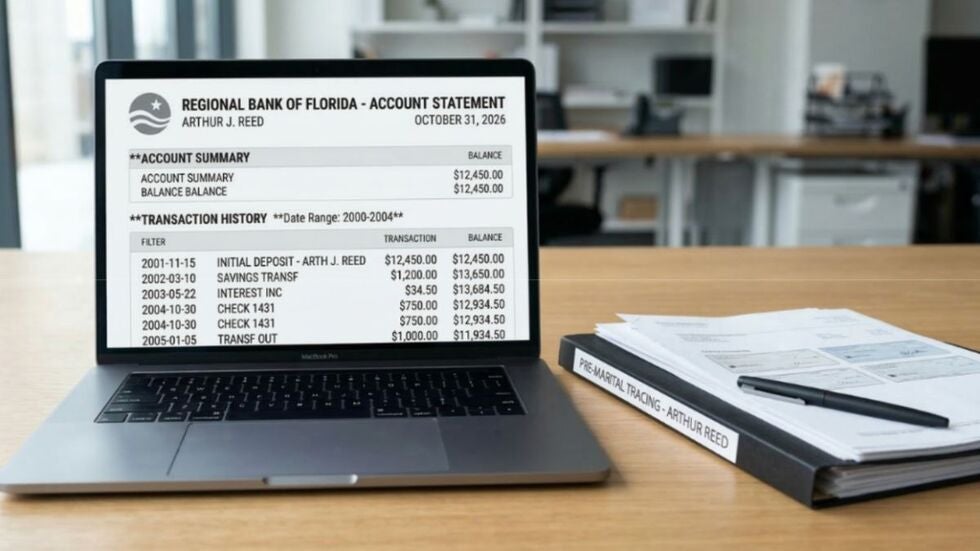
In Florida equitable distribution, the court generally “sets apart” each spouse's nonmarital assets and liabilities before dividing marital property. Nonmarital assets and liabilities are items the law typically treats as belonging to only one spouse, so they are usually not divided as part of equitable distribution. Nonmarital status can be lost, however, if assets are commingled or retitled in a way that shows an intent to treat them as marital.
Common Examples of Nonmarital Property and Debt
-
Property owned before the marriage
If you owned an asset or had a debt before you married, it is often treated as nonmarital. Examples can include a home purchased before marriage, a vehicle, or student loans. However, the classification can change if you add your spouse to the title, or if marital funds are used in a way that converts part of the asset into marital property.
-
Gifts or inheritances intended for one spouse
Property or money you receive from someone other than your spouse, such as an inheritance or a gift from a parent, is generally nonmarital if it is intended for you alone. A key risk is commingling, meaning mixing that property with marital funds in a way that makes it harder to trace and treat as separate.
-
Income from nonmarital assets
Income generated by a nonmarital asset can be treated as nonmarital, but how you handle it matters. If it is used for household expenses or treated as joint money, it can raise disputes about whether it stayed separate. Keeping clear records and separate accounts can help support a nonmarital claim.
-
Property excluded by a valid agreement
A valid prenuptial or postnuptial agreement can define what stays separate. If an agreement excludes certain assets or liabilities from being shared, those items are generally treated as nonmarital.
-
Debt created by forgery or fraud
If a spouse incurs a debt by signing the other spouse's name without consent, that debt may be considered the responsibility of the spouse who forged the signature. These situations are fact-specific and often require proof of the misconduct.
-
Real estate gifts or inheritances kept titled in one name
Real estate inherited during the marriage that remains titled solely in one spouse's name is generally considered nonmarital. However, the classification can change under the following conditions:
-
-
Retitling: If the inherited property is retitled to include the spouse's name, it may be considered marital property, particularly if marital funds are used for improvements or upkeep.
-
Commingling: If marital funds are used to maintain, improve, or pay off the property (such as a mortgage), the property's classification can change. Even if the title remains in one spouse's name, the use of marital resources can create a marital component.
-
Joint Use: If the inherited property is used jointly, for example, if both spouses live in the property or it is used for business purposes by both, this can convert the property into marital property. Clear documentation and a separate agreement can help avoid this issue.
-
Cutoff Dates in Florida Equitable Distribution
Cutoff dates are important because they set the line for what gets identified and classified as marital versus nonmarital. Florida Statutes § 61.075(7) states that the cutoff date for determining assets and liabilities to be identified or classified as marital is whichever comes first:
-
The date of a valid separation agreement;
-
Another date expressly set by that agreement;
-
Or the date a petition for dissolution is filed.
Florida courts may select the valuation date—or even different dates for different assets—when the judge finds that approach just and equitable under the circumstances.
Why the Cutoff Date Matters
The cutoff date helps limit what gets pulled into the marital estate. For example, once a divorce is filed, one spouse generally cannot take on new credit card debt and automatically treat it as a shared marital obligation.
Additionally, this rule matters because many couples live “separate lives” before filing, but that does not always change classification. Courts have emphasized that the cutoff date must follow the statute's plain language when there is no valid separation agreement setting a different date.
Valuation Dates Are Not Always the Same as the Cutoff Date
The cutoff date is used for classification, but the court can use different dates to value marital assets, depending on what is fair in the circumstances. Some assets may be valued closer to separation or filing, while others may be valued closer to trial, depending on the asset type and what happened to it during the case.
Interim Partial Equitable Distribution While the Case Is Pending
Florida law allows a court to order an interim partial distribution of certain assets and liabilities while the divorce case is still pending, but this is not automatic. The statute requires a sworn motion and a finding of good cause.
When an Interim Distribution Is Requested
An interim partial distribution is typically raised when waiting for the final judgment would create a practical or financial problem that needs immediate action. Examples often include:
-
Preventing the loss of an asset or housing due to repossession, foreclosure, or similar urgent risk
-
Avoiding a default on a marital debt or preventing a tax lien type issue
-
Making funds available for attorney fees and costs in circumstances the court finds appropriate
What the Court Must Do in an Interim Distribution Order
If the court finds good cause, the interim order must:
-
Identify and value the marital and nonmarital assets and liabilities that are the subject of the sworn motion
-
Set apart the nonmarital assets and liabilities
-
Provide for a partial distribution of the marital assets and liabilities
How It Affects the Final Equitable Distribution
An interim partial distribution does not replace the final distribution. Any property or funds distributed early must be accounted for in the final equitable distribution, so the overall division of the marital estate remains fair in light of what was already distributed.
Cost, Process, and Timeline for Equitable Distribution in Miami, FL

The cost and timeline depend on how complex the finances are and how much disagreement exists. A case with one home and a few accounts can move faster than a case with multiple properties, a business, or missing records. Court scheduling can also affect timing, especially if hearings are needed.
Most cases follow a similar set of steps, even if the details differ. These steps help you move from uncertainty to a clear proposal that can be negotiated or presented to the court.
-
Gather records (bank statements, tax returns, account statements/screenshots).
-
Identify and classify assets and debts as marital or nonmarital under Florida law.
-
Value major items (real estate, retirement accounts, business interests).
-
Draft a proposed split showing who receives what and how any equalizing payment works.
-
Negotiate or mediate; if unresolved, a judge decides disputed items.
A common slowdown is missing paperwork, especially when one spouse handled most accounts. Another slowdown is valuation disputes, like competing opinions on the value of a condo near Bayside Marketplace or a home near Miracle Mile.
Helpful Documents to Gather Before Negotiations
You do not need to collect everything at once, but it helps to start with the basics. Two good early goals are getting a clear account list and saving key documents in one place.
-
Recent bank statements (balances and transfers)
-
Tax returns (income sources; may reveal hidden accounts)
-
Mortgage statements (payoff amounts, payment history)
-
Retirement statements (contributions and growth)
-
Credit card statements (debt amounts and spending patterns)
Once you have a base file, you can spot gaps more easily. Then you can decide what needs follow-up, like an appraisal for a home near Coral Way or more details about a business account.
Also Need Help with Alimony?
Issues involving equitable distribution often overlap with questions about alimony, particularly when evaluating each spouse's financial circumstances after a marriage ends. Our firm assists clients with alimony matters alongside property and debt division, including analyzing income, expenses, and other factors that may affect whether support is requested, modified, or contested. By addressing equitable distribution and alimony together, we help clients gain a clearer understanding of how these issues interact and what options may be available as they move forward.
Service Areas
We serve families across Florida, including:
-
Miami
-
Orlando
If you are nearby but not listed, contact us anyway. Many clients in Brickell, Downtown Miami, Little Havana, and Kendall start with a call and a clear plan for next steps.
Frequently Asked Questions
What is Equitable Distribution?
Equitable distribution is the process by which the court divides marital assets and debts in a divorce. Under Florida law, the court must first identify and set aside each spouse's nonmarital property, then begin with the idea that everything else (marital property) should be divided equally—unless fairness demands otherwise.
What's the Difference Between Marital and Nonmarital Assets?
-
Nonmarital assets are things you owned before the marriage, inherited or received as a gift (not from your spouse), or were kept separate during the marriage.
-
Marital assets and debts include property, retirement accounts, and liabilities acquired during the marriage, regardless of whose name is on them.
The court will set aside nonmarital assets before dividing what's left.
Does the Court Always Split Things 50/50?
No, the court does not always split things 50/50. While equal distribution is the starting point, the court can divide assets unequally if it's justified by specific factors like:
-
One spouse sacrificed a career for the family
-
Unequal financial circumstances
-
One spouse dissipated (wasted) marital assets
What Factors Can Justify Unequal Distribution?
The factors that can justify unequal distribution includes:
-
Each spouse's contributions to the marriage, like child-rearing or homemaking
-
The length of the marriage
-
Any career interruptions for the family
-
Whether one spouse helped the other advance their education or career
-
The economic situation of each spouse after divorce
-
Whether it's best for a child to remain in the marital home
-
If one spouse wasted or hid marital assets before or during the divorce
Can I Keep the House if I'm the Primary Caregiver for Our Child?
Yes, it is possible that you can keep the house if you're the primary caregiver for your child. Courts may award exclusive use of the marital home to a parent if:
-
It's in the best interest of the child
-
It's financially reasonable
-
Other legal factors support that arrangement
This is often a temporary situation, lasting until the child is emancipated or another court order changes it.
What Happens If My Spouse Wasted or Hid Marital Assets?
If your spouse wasted or hid marital assets—especially in the two years before or after filing for divorce—the court can consider that in the distribution. It could mean you get a larger share to make up for the lost value.
Approach Equitable Distribution with Structure

Equitable distribution is not only about numbers, but it is also about protecting your future and reducing chaos during a hard transition. When the asset list is clear, values are grounded, and cutoff date issues are handled correctly, negotiations often become more focused and less emotional.
Segarra & Associates, P.A. helps clients across Florida approach equitable distribution with structure and plain language. Whether your case involves a home in Miami, retirement savings built over decades, or a business that supports your family, we help you sort the facts and move toward a workable plan.
Protect What You've Built During Divorce
Call Segarra & Associates, P.A. at (305) 742-5042
Disclaimer: This article provides general information and does not serve as legal advice. For legal concerns, consult a licensed attorney. Viewing or interacting with this content does not create an attorney-client relationship. This includes submitting a form, leaving a comment, sending a message, making a call, or leaving a voicemail. Laws may vary by jurisdiction. Laws are subject to change; always verify current legal requirements with a qualified professional. Remember that each case is different, the results of each case will vary, and that all videos posted on this website are not legal advice.
© All Rights Reserved.
Engagement Notice:
An attorney–client relationship with Segarra & Associates, P.A. begins only upon a written agreement and retainer payment, confirmed in a signed engagement letter. Do not send confidential information until such an agreement is executed.
Jurisdictional Statement:
Segarra & Associates, P.A. practices law exclusively within the State of Florida. Representation in other jurisdictions may involve association with local counsel.