
When a Florida family law case is still pending, temporary court orders can shape how the parties handle support, parenting time, property, insurance, fees, and other urgent obligations before a final judgment is entered. If one party refuses to follow those orders, the other party may need to take legal action before the case moves further off track. Segarra & Associates, P.A. helps clients in Florida address violations of pre-final judgment court orders with a clear legal strategy, organized documentation, and focused courtroom advocacy.

If You Are Facing Issues with a Temporary Court Order, Call Segarra & Associates, P.A.
Call Segarra & Associates, P.A. at (305) 742-5042
What Is a Pre-Final Judgment Court Order?
A pre-final judgment court order is an order entered before the court issues a final judgment in the case.
In Florida family law matters, temporary orders are commonly used to stabilize important issues while litigation is pending. Depending on the facts of the case, these orders may address:
-
temporary alimony
-
temporary child support
-
temporary parenting plans
-
exclusive use of the marital residence
-
payment of household expenses
-
attorney's fees and costs
-
insurance obligations
-
temporary injunctions
-
discovery compliance
-
and restrictions involving marital finances or property
These orders remain enforceable unless modified by the court.
A party who disagrees with a temporary order must seek lawful relief through the court process. Ignoring the order entirely can expose the violating party to enforcement proceedings, contempt allegations, sanctions, fee awards, and other court intervention.
Enforcing Prenuptial Agreements During Pending Divorce Litigation
Prenuptial agreements often become major litigation issues long before a case reaches final judgment.
Under Florida's Premarital Agreement Act, § 61.079, valid prenuptial agreements may address issues involving:
-
property rights
-
alimony waivers
-
debt allocation
-
business ownership
-
inheritance rights
-
and financial responsibilities between spouses
When one spouse attempts to ignore the agreement, delay enforcement, or challenge its validity without legal support, the issue can significantly affect temporary support, litigation strategy, settlement leverage, and overall case direction.
At Segarra & Associates, P.A., we help clients address disputes involving the enforceability and interpretation of prenuptial agreements, including issues involving financial disclosures, property characterization, alimony waivers, and related temporary relief requests while the divorce is still pending.
Enforcing Status Quo and Standing Temporary Orders
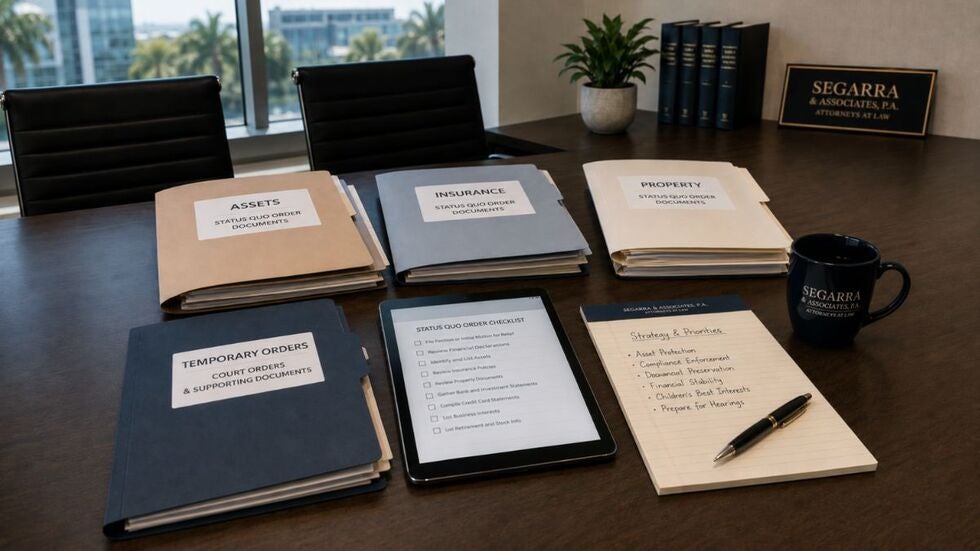
Many Florida judicial circuits enter standing temporary or “status quo” orders at the beginning of a divorce case.
These orders are designed to preserve financial stability and minimize disruption while the litigation proceeds. Depending on the county and the wording of the order, restrictions may involve:
-
transferring or hiding marital assets
-
changing beneficiaries
-
cancelling insurance
-
unusual spending
-
removing children from school
-
relocating children
-
interfering with parenting schedules
-
or incurring unreasonable debt
Violations of these orders can create immediate legal and financial consequences.
Common disputes may involve:
-
draining joint bank accounts
-
hiding funds
-
selling marital property
-
borrowing against assets
-
cancelling insurance coverage
-
locking a spouse out of accounts
-
or disrupting established parenting routines
In some cases, emergency court intervention may become necessary to prevent further damage to marital assets or protect the best interests of the children.
Our firm helps clients pursue enforcement remedies that may include:
-
motions for contempt
-
motions to enforce
-
temporary injunctions
-
emergency relief
-
fee requests
-
sanctions
-
and other remedies permitted under Florida law depending on the facts of the case.
Enforcement of Temporary Support and Fee Orders
Temporary support orders are often critical to maintaining financial stability during pending divorce litigation.
When one spouse refuses to comply with temporary support obligations, the consequences can quickly affect:
-
housing
-
utilities
-
childcare
-
access to medical care
-
litigation preparation
-
and the overall balance of the case itself
Temporary orders may involve:
-
temporary alimony
-
temporary child support
-
payment of household expenses
-
mortgage obligations
-
vehicle expenses
-
insurance premiums
-
or temporary attorney's fees and costs
In many Florida divorce cases, temporary attorney's fee awards are especially important because they help level the playing field between spouses with unequal financial resources.
Unfortunately, some litigants attempt to use financial pressure as leverage during the case by refusing to comply with support or fee obligations.
Florida courts may address these violations through enforcement proceedings, contempt motions, fee awards, sanctions, garnishment remedies, or other corrective measures depending on the circumstances and the language of the order.
Enforcement of Parenting and Temporary Timesharing Orders
Few issues become more emotionally charged than disputes involving children during pending divorce litigation.
Temporary parenting orders and temporary timesharing schedules are intended to provide consistency and stability for children while the case remains unresolved. When one parent refuses to comply with the schedule, withholds the children, interferes with communication, or unilaterally changes important arrangements, the conflict can escalate quickly.
Common disputes may involve:
-
denied visitation
-
withholding children
-
school disagreements
-
refusal to exchange children
-
interference with communication
-
relocation concerns
-
or repeated violations of temporary parenting schedules
Depending on the circumstances, courts may consider remedies involving:
-
enforcement motions
-
contempt proceedings
-
make-up timesharing
-
modifications to temporary arrangements
-
fee awards
-
or other relief designed to protect the children's best interests and restore compliance.
Enforcement of Financial Disclosure and Discovery Obligations
One of the most common battlegrounds in contested Florida divorce litigation involves financial disclosure and discovery compliance.
Florida family law cases often require extensive financial transparency. Parties may be required to produce:
-
bank statements
-
business records
-
tax returns
-
credit card statements
-
payroll information
-
investment records
-
loan documents
-
and other financial materials relevant to support and equitable distribution issues
When a party refuses to comply with mandatory disclosure requirements, delays production, conceals records, provides incomplete information, or ignores discovery obligations, enforcement proceedings may become necessary.
Discovery disputes can significantly delay litigation and increase costs for both parties.
Depending on the facts, enforcement efforts may involve:
-
motions to compel
-
requests for sanctions
-
forensic accounting review
-
subpoenas
-
fee requests
-
evidentiary hearings
-
or court orders compelling production of records
In high-conflict cases involving closely held businesses, self-employment income, or complex financial structures, these disputes can become especially significant.
Enforcement of Insurance and Financial Protection Orders
Temporary orders frequently require parties to maintain existing insurance coverage while the case is pending.
Depending on the court order and the facts involved, this may include:
-
health insurance
-
life insurance
-
automobile insurance
-
homeowners insurance
-
or other coverage protecting the parties, children, or marital property
Problems may arise when a party:
-
cancels coverage
-
stops paying premiums
-
removes a spouse or child from a policy
-
changes beneficiaries
-
or allows coverage to lapse during litigation
These situations can create immediate financial exposure and significant stress for families already dealing with ongoing litigation.
Courts may address these violations through enforcement proceedings, reimbursement orders, reinstatement requirements, contempt motions, fee awards, or other remedies supported by Florida law and the facts of the case.
Enforcement Strategies Depend on the Facts of the Case
Not every violation requires the same legal response.
Depending on the circumstances, enforcement litigation may involve:
-
motions for contempt
-
motions to enforce
-
emergency motions
-
temporary injunctions
-
sanctions
-
attorney's fee requests
-
evidentiary hearings
-
negotiated compliance
-
mediation
-
or coordinated financial analysis with outside professionals
A successful enforcement strategy usually requires more than simply proving a violation occurred.
Courts often evaluate:
-
the wording of the original order
-
whether the violation was willful
-
whether compliance was possible
-
the credibility of the parties
-
the urgency of the issue
-
and the specific remedy being requested
In many cases, organized evidence and strategic preparation can significantly affect the outcome.
Our Approach to Pre-Final Judgment Enforcement Litigation
At Segarra & Associates, P.A., we understand that temporary court orders often affect the most sensitive and stressful parts of a client's life:
-
parenting time
-
financial stability
-
business operations
-
housing
-
insurance
-
and litigation resources
Our firm helps clients throughout Miami-Dade, Broward, Fort Lauderdale, Orlando, and surrounding Florida communities pursue practical and strategic solutions when temporary court orders are ignored or violated.
We assist clients with:
-
evaluating enforcement options
-
preparing motions for contempt or enforcement
-
organizing financial documentation
-
addressing emergency violations
-
responding to allegations of noncompliance
-
pursuing attorney's fees and sanctions when appropriate
-
and preparing for contested evidentiary hearings
Every family law case is different. Some enforcement disputes can be resolved through negotiated compliance. Others require immediate and aggressive court intervention to protect children, preserve assets, or restore financial stability during the litigation process.
Frequently Asked Questions
How do I enforce a court order in Florida?
To enforce a court order in Florida, a party typically files a motion explaining:
-
the existing court order
-
the specific violation
-
and the relief being requested from the court
Depending on the circumstances, enforcement proceedings may involve:
-
motions for contempt
-
motions to enforce
-
emergency motions
-
requests for attorney's fees
-
sanctions
-
or evidentiary hearings
The appropriate legal strategy depends on the language of the order, the type of violation involved, and whether the noncompliance appears willful.
Can a court order be enforced before a final judgment?
Yes. Temporary court orders entered before final judgment are legally enforceable in Florida family law cases.
Pre-final judgment orders often address:
-
temporary support
-
parenting schedules
-
attorney's fees
-
insurance obligations
-
use of the marital home
-
financial restrictions
-
and discovery obligations
A party who violates a temporary order may face enforcement proceedings even before the divorce is finalized.
What happens if someone ignores a temporary order in a Florida divorce?
Ignoring a temporary order can create serious legal consequences.
Depending on the facts of the case, the court may:
-
order compliance
-
award attorney's fees
-
impose sanctions
-
award make-up parenting time
-
require repayment of money
-
compel production of records
-
issue injunctions
-
or hold the violating party in contempt
Courts often evaluate whether:
-
the order was clear
-
compliance was possible
-
and the violation was willful.
How long does it take to enforce a pre-final judgment court order in Florida?
The timeline depends on:
-
the court's schedule
-
the urgency of the issue
-
the complexity of the dispute
-
and whether an evidentiary hearing is required
Emergency matters involving children, financial misconduct, hidden assets, or insurance issues may sometimes be addressed more quickly than routine enforcement disputes.
Can a person go to jail for violating a family court order in Florida?
In some situations, Florida courts may use civil contempt proceedings to compel compliance with court orders.
Whether incarceration is legally appropriate depends on several factors, including:
-
the type of order involved
-
whether the violation was willful
-
and whether the person has the present ability to comply with the order
Contempt proceedings are highly fact-specific and often require careful legal analysis.
What is the difference between enforcement and modification in Florida family law?
Enforcement focuses on requiring compliance with an existing court order.
Modification involves asking the court to legally change the existing order due to a substantial change in circumstances.
For example:
-
refusing to pay temporary support may create an enforcement issue
-
while a legitimate loss of income may create a modification issue
In some cases, both issues may arise simultaneously.
Can temporary child support or alimony be enforced before trial?
Yes. Temporary support orders entered during pending litigation are enforceable before trial.
If a party refuses to comply with temporary support obligations, the other party may seek:
-
enforcement
-
contempt
-
attorney's fees
-
sanctions
-
garnishment remedies
-
or other relief authorized under Florida law
Temporary support disputes can significantly affect financial stability while the case remains pending.
What happens if my spouse refuses to provide financial documents during the divorce?
Florida family law cases generally require financial disclosure and compliance with discovery obligations.
If a spouse refuses to produce records such as:
-
bank statements
-
tax returns
-
business records
-
payroll information
-
or investment documents
the court may address the issue through:
-
motions to compel
-
sanctions
-
attorney's fee awards
-
subpoenas
-
evidentiary hearings
-
or other enforcement remedies
Discovery disputes are especially common in high-conflict or business-related divorce litigation.
Can a parent refuse temporary timesharing before final judgment?
A parent generally cannot unilaterally ignore or violate a court-ordered temporary parenting schedule.
When disputes arise involving:
-
denied visitation
-
withholding children
-
refusal to exchange children
-
school disagreements
-
or interference with communication
the court may consider enforcement remedies designed to protect the children's best interests and restore compliance.
What if my spouse drains bank accounts or hides money during the divorce?
Florida courts may address attempts to:
-
hide assets
-
transfer funds
-
dissipate marital property
-
or violate standing temporary orders during pending litigation
Depending on the circumstances, enforcement efforts may involve:
-
emergency motions
-
temporary injunctions
-
forensic accounting review
-
contempt proceedings
-
fee requests
-
or other court intervention aimed at preserving marital assets.
Are prenuptial agreements enforceable during a pending divorce case?
Yes. Prenuptial agreements are often litigated and enforced before final judgment in Florida divorce proceedings.
Disputes involving prenups may affect:
-
temporary support
-
property claims
-
litigation strategy
-
and settlement negotiations while the case is pending
Florida courts may evaluate:
-
enforceability
-
financial disclosures
-
voluntariness
-
and the language of the agreement itself depending on the issues raised in the case.
Segarra & Associates, P.A. Can Help You

If a temporary court order is being ignored, do not wait until the final judgment to understand your options. Segarra & Associates, P.A. can help you review the order, identify the violation, organize your evidence, and seek appropriate relief through the Florida family court system.
For a Confidential Consultation, Call Segarra & Associates, P.A.
Call Segarra & Associates, P.A. at (305) 742-5042
Disclaimer: This article provides general information and does not serve as legal advice. For legal concerns, consult a licensed attorney. Viewing or interacting with this content does not create an attorney-client relationship. This includes submitting a form, leaving a comment, sending a message, making a call, or leaving a voicemail. Laws may vary by jurisdiction. Laws are subject to change; always verify current legal requirements with a qualified professional. Remember that each case is different, the results of each case will vary, and that all videos posted on this website are not legal advice.
© All Rights Reserved.
Engagement Notice:
An attorney–client relationship with Segarra & Associates, P.A. begins only upon a written agreement and retainer payment, confirmed in a signed engagement letter. Do not send confidential information until such an agreement is executed.
Jurisdictional Statement:
Segarra & Associates, P.A. practices law exclusively within the State of Florida. Representation in other jurisdictions may involve association with local counsel.